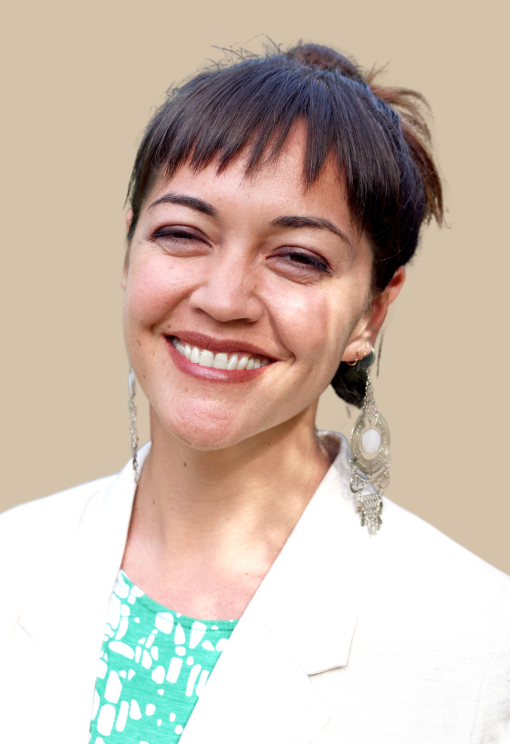
Joanne Qina'au, PhD, MA, E-YT750
- Postdoctoral Research Fellow, Osher Center for Integrative Health
Research Interests
- Reducing health disparities in underserved communities (e.g., Native Hawaiians, Indigenous groups, SGM, global majority)
- Reimagining wellbeing theory, measurement, and intervention design through decolonialism and indigenizing
- Exploring the intersections of Indigenous wellbeing and mind-body practices
- Designing and testing culturally grounded interventions through implementation science and mixed-methods research approaches
- Leading community-based research in the reduction of transdiagnostic symptoms of traumatic stress for underserved communities and individuals
- Advancing integrative health equity and multi-eyed seeing in behavioral healthcare
Experience and Current Work
Dr. Qinaʻau is a Kanaka ʻŌiwi integrative clinical psychologist and NIH National Center for Complementary and Integrative Health T32 research fellow whose program of research advances health equity for Indigenous and underserved communities through the development of culturally grounded theory, measurement, and intervention. Through NIH/NIMHD-funded community-based participatory research, Dr. Qinaʻau developed KANU Theory (Ke Ao Nōweo ʻUla) — the first theory of wellbeing for Native Hawaiians with behavioral health challenges — which positions colonialism as an upstream determinant of health while identifying culturally grounded processes as both protective and empowering. Building on KANU Theory, Dr. Qinaʻau developed Kukui Mālamalama, the first decolonial wellbeing measure for Native Hawaiians, through a mixed-methods approach. They also developed the Moʻohihia Model, a conceptual framework mapping how settler colonial structures produce stress pathways and health inequities in Indigenous communities.
Translating this theoretical foundation into intervention science, Dr. Qinaʻau designed Pilina Welo, a program grounded in Native Hawaiian ontological conceptions of wellbeing that is trauma-informed, multi-modal, and community-funded. Drawing on a multi-eyed seeing approach (integrating health and healing paradigms from multiple sources) Pilina Welo has demonstrated strong feasibility and acceptability and is being positioned for adaptation and a rigorous pilot trial in behavioral healthcare settings. Dr. Qinaʻau also leads Mindful CREW (Mindful Community Regulating Bias for Equity and Wellbeing), a funded mindfulness-based program for health professionals designed to advance cultural safety and integrative health equity. Developed through participatory research, MBI foundations, and evidence-based bias regulation strategies, Mindful CREW is being prepared for implementation across UCSF Osher Centers. Together, these programs offer novel, implementation science-grounded pathways to reducing health disparities, one centering Indigenous community wellbeing, the other equipping health professionals to deliver more equitable care.
In complementary lines of inquiry, Dr. Qinaʻau has examined physical activity as a protective factor against transdiagnostic symptoms of interpersonal developmental trauma among Native Hawaiians, and explored the role of trauma, identity, and wellbeing in Mixed emerging adults. Their work also includes culturally grounded adaptation of Acceptance and Commitment Therapy across ethnoracial groups. Dr. Qinaʻau collaborates on two NIH-funded research networks (Mechanisms Underlying Mind-Body Interventions & Measurement of Emotional Well-Being Network and the Plasticity of Well-being Network), contributing to a systematic review of school-based mindfulness interventions and meta-analytic examination of interoceptive awareness and emotional wellbeing. Their scholarship spans peer-reviewed publications across integrative health, psychological science, public and global health, Indigenous studies, and community-based research, and includes an accepted scoping review of Indigenous models and frameworks of wellbeing from Turtle Island and Moananuiākea. Dr. Qinaʻau's work addresses Indigenous wellbeing, sustainability, and the climate crisis as interconnected determinants of community health.
Education and Training
- PhD, Clinical Psychology, University of Hawaiʻi at Mānoa
- Clinical Fellow in Psychology, Department of Psychiatry at Harvard Medical School, Beth Israel Deaconess Medical Center at Massachusetts Mental Health Center
- Research Fellow, Mechanisms Underlying Mind-Body Interventions & Measurement of Emotional Well-Being Network
- Emerging Scholar, Plasticity of Well-being Research Network
- MA, Psychology in Education (Clinical Psychology), Teachers College, Columbia University
- BA, English Literature, Tufts University
- Certified Experienced Yoga Teacher and Trainer E-YT750
- Mindfulness-Based Stress Reduction Qualified Teacher
Publications
Qinaʻau, J., Yanger Mariano, A., Kahili-Heede, M. K., Kone, S.Q., Rivera, C., Chatto, S., Clack, V. J., Johnson, F. N., Johnson-Jennings, M., & Antonio, M. C. K.. (2026) A systematic scoping review for decolonial public and global health: Indigenous frameworks and models of wellbeing from Turtle Island and Moananuiākea. Frontiers in Public Health.
Qinaʻau, J., Kaholokula, J. K., Nakamura, L., Austin Seabury, A., Preston-Pita, H., Chan, K., Dudoit-Tagupa, F., Baclayon, K. K. P., Johnson, K. M. F. H., Chung-Do, J. J., Spencer, S. D., Stueber Svec, K., Manzana, D., Firoozan, A., & Sasaki, J. Y. (in press). Decolonial wellbeing theory: Indigenous psychology and the return to psychology's spiritual roots. Journal of Indigenous Social Development.
Qinaʻau, J., & Goto, K. (in press). Pilina Welo: A wellbeing intervention grounded in Native Hawaiian and contemplative theory and practice. In L. M. Dunn & T. B. Wakpa (Eds.), Mindfulness, movement, and cultural revitalization: Indigenous contemplative theories and practices. Springer Netherlands.
Qinaʻau, J., Rivera, C., Nakamura, L., Souza, P., Helelā, M., & Austin Seabury, A. A. (in press). Using the Moʻohihia model, decolonialism, and culture-as-health in therapeutic settings for Pacific Islanders at home and in diaspora. In G. E. Allen & L. D. McCubbin (Eds.), Pasifika psychology: Affirming Pacific Islander mental health. American Psychological Association.
Qina‘au, J., Masuda, A., & Spencer, S. (in press). Acceptance and Commitment Therapy Among Ethnoracial Groups. In Chang, E., Lucas, A. (Eds.), Cognitive and Behavioral Interventions with Ethnoracial Groups: Clinical Strategies and Techniques for the Springer Nature series CBT: Science into Practice. Springer Nature.
Heke, D., Vera, M., Albarrán González, D., Bakic, T., Gaudet, J. C., McGuire-Adams, T., Park, M. L., Qinaʻau, J., Smith, H., & Whiskeyjack, L. (in press). Indigenous bodies of knowledge: Embodied [self] care and planetary health. Springer Nature.
Qinaʻau, J., Chao, M. T., Austin Seabury, A. A., & Antonio, M. C. K. (2025). Imagining Indigenized futures: Multi-eyed seeing and decolonialism in integrative health equity. Global Advances in Integrative Medicine and Health.
Renna, M. E., Spaeth, P. E., Behringer, K. F., Qinaʻau, J., Clayton, M., & Mennin, D. S. (2025). A pilot study examining differential relationships between inflammation and emotion dysregulation across young and middle adulthood. Health Psychology.
Treves, I. N., Chen, Y.-Y., Wilson, C. L., Verdonk, C., Qinaʻau, J., Pustejovsky, J. E., Goldberg, S. B., Mehling, W., Schuman-Olivier, Z., & Khalsa, S. S. (2025). A meta-analysis of the effects of mindfulness meditation training on self-reported interoception. Scientific Reports, 15(1), Article 38889.
Masuda, A., Nakamura, L., Preston-Pita, H., Hermosura, S., Morgan, L., Stueber, K., Spencer, S. D., Qinaʻau, J., & Austin-Seabury, A. A. (2024). Native Hawaiians’ Views on Depression and Preferred Behavioral Health Treatments: A Preliminary Qualitative Investigation. The Journal of Behavioral Health Services & Research, 51(2), 203–218.
Qina‘au, J., Hill, P. L. (2023). Finding Direction for Purpose Research in Hawai‘i: A Narrative Review. Hawai‘i Journal of Health & Social Welfare, 83(4), 108-112.
Qina‘au, J., Spencer, S., & Sasaki, J. (2023). Trauma in Mixed vs. Monoracial Emerging Adults in Hawaiʻi: Implications for Mindfulness, Psychological Distress, and Wellbeing. International Journal for the Advancement of Counselling, 46(1), 1-19.
Qina‘au, J., & Antonio, M. C. (2022). Wellbeing for all: Indigenizing theories and measures of wellbeing for equitable sustainability. Frontiers in Psychology, 13. doi.org/10.3389/fpsyg.2022.979109
Qina‘au, J., Edmonds, G. W., & Hill, P. L. (2022). Native Hawaiian wellbeing and transdiagnostic trauma symptoms: The protective role of physical activity in dissociation. European Journal of Trauma & Dissociation, 6(4), 100296.
Spencer, S. D., Jo, D., Antonio, M., Qina‛au, J., Hishinuma, E. S., Hamagami, F., & Masuda, A. (2022) A Psychometric Validation of Contextual Cognitive Behavioral Therapy-Informed Measures with Racially and Ethnically Diverse Adults. Journal of Contextual Behavioral Science, 25, 61-72.
Masuda, A., Morgan, L., Spencer, S.D., Qina‘au, J., & Jo, D. (2022) Cultural adaptations of acceptance and commitment therapy. In Twohig, M.P., Levin, M.E., & Petersen, J.M. (Eds.), The Oxford Handbook of Acceptance and Commitment Therapy. Oxford University Press.
Masuda, A. & Qinaʻau, J. (2022). Application of Secular Mindfulness to Asian Americans in the U.S.: Cultural Considerations. In C.M. Fleming, J. Proulx, & V. Womack (Eds.). Beyond White Mindfulness: Critical Perspectives on Racism, Well-being, and Liberation. Routledge.
Masuda, A., Qinaʻau, J., Juberg, M., & Martin, T. (2021). Bias in the Diagnostic and Statistical Manual 5 and Psychopathology. In L. Benuto, M. Duckworth, A. Masuda, & W. O’Donohue (Eds.). Prejudice, Stigma, Privilege, and Oppression: A Behavioral Health Handbook. Springer Publications.
Pilla, D., Qina‘au, J., Patel, A., Meddaoui, B., Watson, N., Dugad, S., & Saskin, M. (2020). Toward a Framework for Reporting and Differentiating Key Features of Meditation-and Mindfulness-Based Interventions. Mindfulness, 11(11), 2613-2628.
Qinaʻau, J. & Masuda, A. (2020). Cultural Considerations in Establishing Rapport: A Functional Contextualist View on Common Factors. In L. Benuto, F. Gonzalez, & J. Singer (Eds.). Handbook for Cultural Factors in Behavioral Health: A Guide for the Helping Professional. New York: Springer Publications.